The Great Realignment: Malala’s DCP Gambit and the Shifting Sands of 2027
In the high-octane corridors of Nairobi’s political scene, the 2027 General Election has arrived three years early. As traditional coalitions fracture under the weight of the 'broad-based government' experiment, a new wave of maneuvering—led by figures like Cleophas Malala of the Democracy for the Citizens Party (DCP)—is signaling a radical departure from the 2022 status quo, turning former foes into potential bedfellows in a desperate race for survival.
Kenyan politics is the only theater where the actors change their scripts mid-performance, and the audience discovers that the villain and the hero have been sharing the same dressing room all along.
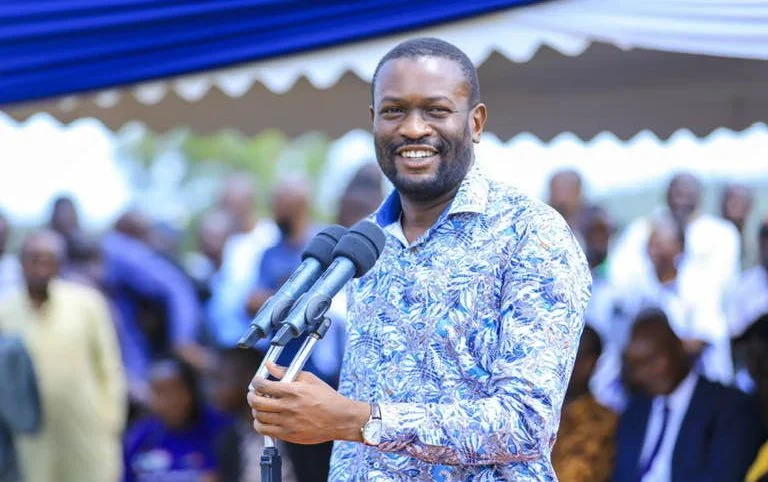
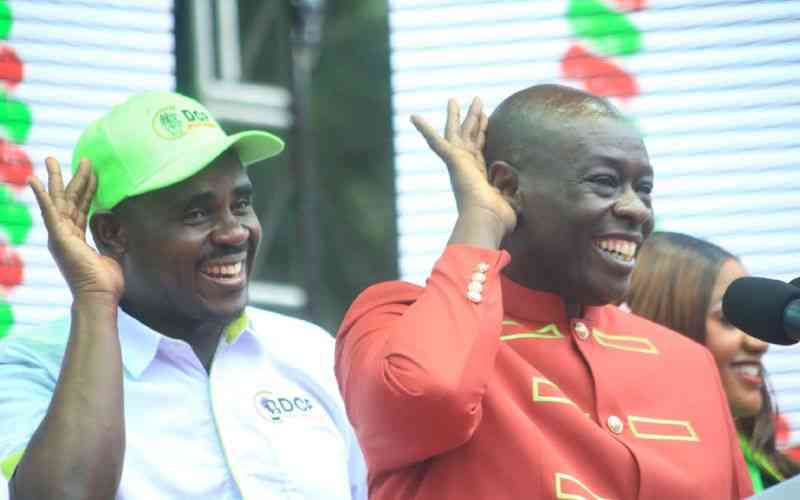
Nairobi’s political climate, usually characterized by a post-election lull, has instead transformed into a frantic laboratory of experimentation. The catalyst for this premature electioneering is a combination of the 'Gen Z' revolutionary spirit that shook the capital in mid-2024 and President William Ruto’s subsequent decision to co-opt the opposition into a 'Broad-Based Government.' This move effectively neutralized the Orange Democratic Movement (ODM) as an oversight body, leaving a vacuum that various political actors are now rushing to fill. At the center of this storm is Cleophas Malala, the former United Democratic Alliance (UDA) Secretary General who has reinvented himself as the Deputy Leader of the Democracy for the Citizens Party (DCP). Malala’s recent public overtures toward his former home, the UDA, have sent shockwaves through the political establishment. By suggesting a potential alliance between the DCP and the ruling party, Malala is highlighting the fluid, almost mercenary nature of Kenyan political loyalty. For many observers, this isn't just about party hop-scotching; it is a tactical retreat and a realignment designed to secure a seat at the high table before the 2027 concrete sets. Malala, a politician known for his oratorical flair and 'grassroots' mobilization, represents a growing class of politicians who realize that standing alone in the current landscape is a recipe for political extinction. His pivot suggests that the DCP is positioning itself as a bridge-builder, or perhaps a 'third force' capable of tilting the scales in a landscape where the traditional 'Hustler vs. Dynasty' narrative has lost its luster. Technically, the 2027 race is being shaped by two major internal ruptures. First is the deepening frost within the Kenya Kwanza administration, specifically the perceived fallout between President Ruto and his Deputy, Rigathi Gachagua. As Gachagua focuses on consolidating the Mount Kenya bloc under the 'one man, one shilling' mantra, Ruto’s allies are looking elsewhere for reinforcements. This is where the DCP and Malala’s 'trending' rhetoric come in. By flirting with a return to the UDA fold or a formal coalition, Malala is offering a buffer for the President against the potential loss of the Central Kenya vote. The DCP, though relatively new in its current configuration, seeks to capture the disillusioned youth and the Western Kenya voting bloc that feels alienated by the current administration's tax policies. Secondly, the entry of ODM luminaries like John Mbadi and Hassan Joho into the Cabinet has left the Azimio la Umoja One Kenya Coalition in a state of terminal decline. Kalonzo Musyoka, the Wiper Democratic Movement leader, has attempted to seize the mantle of the official opposition leader, but he faces a crowded field. The discourse in Nairobi’s high-end hotels and backroom caucuses suggests that a new 'super-coalition' is in the works. This hypothetical 'Redemption Alliance' would likely pit Kalonzo and disgruntled Mt. Kenya leaders against the Ruto-ODM behemoth. In this scenario, Malala’s DCP acts as a wildcard. If Malala successfully negotiates a deal with the UDA, he validates the government’s 'broad-based' strategy. If he remains on the periphery, he could lead a populist charge against the very establishment he once served. Social media has become the primary battleground for these shifting alliances. Malala’s recent posts, which blend populist advocacy with strategic praise for the presidency, have sparked intense debate. Critics call it 'political tourism,' but supporters see it as 'pragmatic diplomacy.' This digital discourse reflects a deeper anxiety among the Kenyan electorate. The 'Gen Z' protests demonstrated that the public is no longer satisfied with ethnic-based voting blocks. Consequently, politicians are desperately trying to rebrand. The DCP’s focus on 'Democracy for the Citizens' is an attempt to co-opt the language of the recent civil unrest, even as its leaders negotiate for positions within the traditional power structures. Furthermore, the 'Raila Factor' remains the elephant in the room. With Raila Odinga focusing his energies on the African Union Commission (AUC) Chairperson seat, his grip on domestic politics has loosened, though not disappeared. His absence from the day-to-day trenches has allowed characters like Malala to assert more influence. The DCP’s strategy appears to involve raiding the traditional ODM strongholds in Western Kenya, presenting themselves as a more youthful, localized alternative that can still 'work with' the government to bring development—a classic Kenyan political trope known as 'kushirikiana na serikali.' However, the path for Malala and the DCP is fraught with risk. The UDA's internal structures are currently undergoing a purge of 'rebel' elements, and it remains to be seen if the ruling party is willing to trust a man who has proven he can pivot at a moment's notice. Moreover, the Nairobi electorate, increasingly sophisticated and cynical, is wary of these early alliances. The 2027 General Election is shaping up to be a contest between the 'Establishment' (a Ruto-ODM hybrid) and a fragmented 'Alternative' (Kalonzo, the Gachagua faction, and the DCP). As we move toward 2025, the fluidity of these alliances will likely increase. The DCP’s deputy leader has set the stage for a season of 'grand auditions,' where loyalty is a commodity and ideology is a footnote. In Nairobi, the joke is that you should never delete a politician’s number, because by next week, they might be your boss, your ally, or your most vocal critic. Cleophas Malala’s current trajectory is a textbook example of this volatility. Whether his DCP-UDA dalliance leads to a formal marriage or remains a fleeting flirtation, it has successfully forced the country to look toward 2027, long before the 2022 wounds have fully healed. The chessboard is set, the pieces are moving, but in Kenya, the rules of the game change with every sunset.